 EN
EN

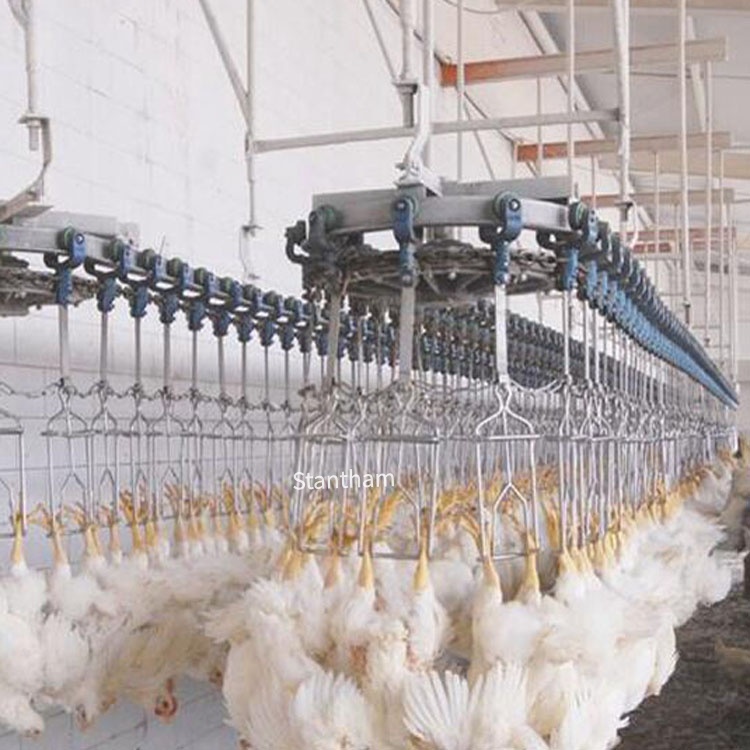
Monitoring What Actually Moves the Needle on Uptime
Uptime in a slaughterhouse isn‘t just about keeping motors spinning. It’s about protecting perishable product, managing labor schedules that run on tight windows, and avoiding the cascading chaos that happens when one station goes down and birds start backing up on the line. The difference between a plant running at 85% availability and one hovering around 65% isn‘t academic—it shows up directly on the weekly P&L.
A 2021 study on a Peruvian poultry processing plant found that integrating Lean Manufacturing and Total Productive Maintenance (TPM) methodologies resulted in a 5.87% increase in equipment availability. That kind of improvement doesn’t come from guessing. It comes from tracking the right metrics and acting on them.
Overall Equipment Effectiveness as the North Star
OEE remains the most widely adopted framework for measuring manufacturing productivity across food processing. It breaks down into three components: Availability, Performance, and Quality. In a slaughterhouse context, Availability tracks whether the line is running when it‘s supposed to be running. Performance measures whether it’s running at the designed throughput rate. Quality captures whether the output meets spec—no contamination, no excessive trimming, no downgrades.
What makes OEE particularly useful in poultry processing is that it forces a conversation about where the losses are actually coming from. A plant might have 90% Availability but only 75% Performance because the evisceration station can‘t keep up with the shackle speed. Another plant might run at full speed but lose 5% of birds to Quality issues because the vent cutter isn’t positioned correctly. Without OEE, those problems look like separate issues. With OEE, they show up as components of a single number that demands attention.
Availability: The Uptime Metric That Starts with Scheduled vs. Unscheduled Downtime
Availability is calculated as actual operating time divided by planned production time. In practice, this means tracking every minute the line stops—and classifying it correctly.
Scheduled downtime includes sanitation breaks, shift changes, and planned maintenance. Unscheduled downtime is where the real leverage sits: breakdowns, jams, power fluctuations, and operator errors. One meat processing case study broke Availability down further into plant/equipment availability, utilisation of available time, and rate of production. The key insight? Most plants overestimate their true Availability because they don‘t rigorously track short stops—those 30-second jams that happen ten times an hour add up to serious losses by the end of the shift.
A practical approach: install event-logging sensors on critical transfer points. One Midwestern poultry operation found that 40% of their unplanned downtime was concentrated at the transition between the scalder and the picker. The fix wasn’t new equipment—it was adjusting the conveyor timing and adding a simple guide rail. Availability jumped from 82% to 89% within two weeks.
Performance: Speed Losses That Hide in Plain Sight
Performance compares actual throughput against the ideal run rate. If a line is designed for 10,000 birds per hour but consistently runs at 8,500, that‘s a 15% performance loss.
The tricky part is that performance losses often get normalized. Operators adjust to running slower because “that’s just how the equipment behaves” or “the birds are bigger this flock.” But those explanations mask real opportunities. A study on throughput in meat processing identified three addressable elements of OEE—availability, utilisation, and rate—and found that rate improvements often delivered the fastest payback because they required no capital investment.
In slaughterhouse environments, performance losses frequently cluster around:
-
Inconsistent bird sizes causing equipment to slow down or jam
-
Worn tooling on evisceration or cutting stations
-
Air pressure drops in pneumatic systems
-
Operator technique variability on manual trimming stations
The fix starts with measuring actual line speed per hour, per shift, per flock. Once that data exists, root causes become visible.
Quality: The Metric That Directly Hits Yield and Revenue
Quality in OEE terms means first-pass yield—product that meets specification without rework or downgrade. In a slaughterhouse, quality failures show up as:
● Contaminated carcasses that require trimming or condemnation
● Incomplete evisceration leading to manual rework
● Skin damage from improper scalding or picking
● Off-spec portion weights in cut-up
These losses are expensive because the bird has already been processed. The cost of a downgraded carcass isn‘t just the lost revenue—it’s the labor, water, energy, and overhead already sunk into getting it to that point.
ASTM standards, specifically Volume 15.12, provide frameworks for evaluating device performance and predictive accuracy in livestock and poultry evaluation systems. These standards matter because they establish baseline expectations for how measurement equipment should perform—and that directly impacts Quality metrics.
Downtime Event Tracking: The Detail That Makes OEE Actionable
OEE is the headline. Downtime event tracking is the story beneath it.
Without knowing why the line stopped, OEE is just a number. The most effective slaughterhouses categorize every downtime event by:
● Equipment type (picker, eviscerator, chiller, conveyor)
● Failure mode (mechanical, electrical, operator-related, material-related)
● Duration (under 5 minutes, 5-30 minutes, over 30 minutes)
● Time of day (first hour after startup, pre-lunch, post-lunch, end of shift)
One poultry plant in the Southeast tracked downtime events for 90 days and discovered that 60% of their extended stops happened between 11:00 AM and 1:00 PM—not because of equipment failure, but because sanitation breaks were poorly coordinated with maintenance schedules. Adjusting the break rotation eliminated 40 minutes of unplanned downtime per day. That‘s 240 hours of additional production capacity annually.
Mean Time Between Failures and Mean Time to Repair
MTBF and MTTR are the operational metrics that feed into Availability. MTBF tells you how reliable a piece of equipment is. MTTR tells you how quickly your team can get it back online.
In slaughterhouse environments, MTBF tends to be lowest on equipment with moving parts in wet, cold, or abrasive conditions—scalders, pickers, and eviscerators. MTTR tends to be longest on equipment with complex mechanical linkages or proprietary control systems.
The practical takeaway: track MTBF and MTTR by equipment type and by shift. If MTTR is significantly longer on night shift than day shift, that‘s a training or staffing issue, not an equipment issue. If MTBF drops during summer months, that’s a temperature or humidity problem that requires environmental controls, not just maintenance.
Real-World Application: A Case from the Field
A 15,000 birds-per-hour greenfield facility recently came online with a single automated line designed for high throughput. The management team placed special emphasis on optimizing the evisceration process, investing in equipment with integrated data-capturing devices that enable real-time production monitoring. The system allows operators to make data-driven adjustments on the fly, improving throughput and minimizing downtime.
What made this approach work was the combination of good equipment and disciplined tracking. The plant didn‘t just install the monitoring system—they built daily review meetings around the data. Shift supervisors came to those meetings with explanations for every downtime event over 10 minutes. Within three months, Availability improved by 6%, and the plant hit its throughput target consistently for the first time.
Table of Contents
- Monitoring What Actually Moves the Needle on Uptime
- Overall Equipment Effectiveness as the North Star
- Availability: The Uptime Metric That Starts with Scheduled vs. Unscheduled Downtime
- Performance: Speed Losses That Hide in Plain Sight
- Quality: The Metric That Directly Hits Yield and Revenue
- Downtime Event Tracking: The Detail That Makes OEE Actionable
- Mean Time Between Failures and Mean Time to Repair
- Real-World Application: A Case from the Field