 EN
EN
The First Question: Why Turnkey Instead of Piecemeal
The decision to adopt a complete chicken slaughterhouse turnkey solution usually starts the same way—a processing manager looking at a scattered collection of secondhand equipment, patchwork conveyors from three different suppliers, and a maintenance log that reads like a novel. The real question isn't whether turnkey makes sense. It's whether the operation can afford not to have a single point of responsibility for the entire line.
A poultry processing plant is not a collection of machines. It's a sequence of tightly coupled processes: stunning, bleeding, scalding, feather removal, evisceration, chilling, cutting, and packaging. When each piece comes from a different vendor, the gaps between them become the problem. One supplier's conveyor doesn't quite match the next supplier's infeed height. The scalder runs at a different speed than the plucker expects. Suddenly the project manager is spending more time coordinating vendors than managing the installation.
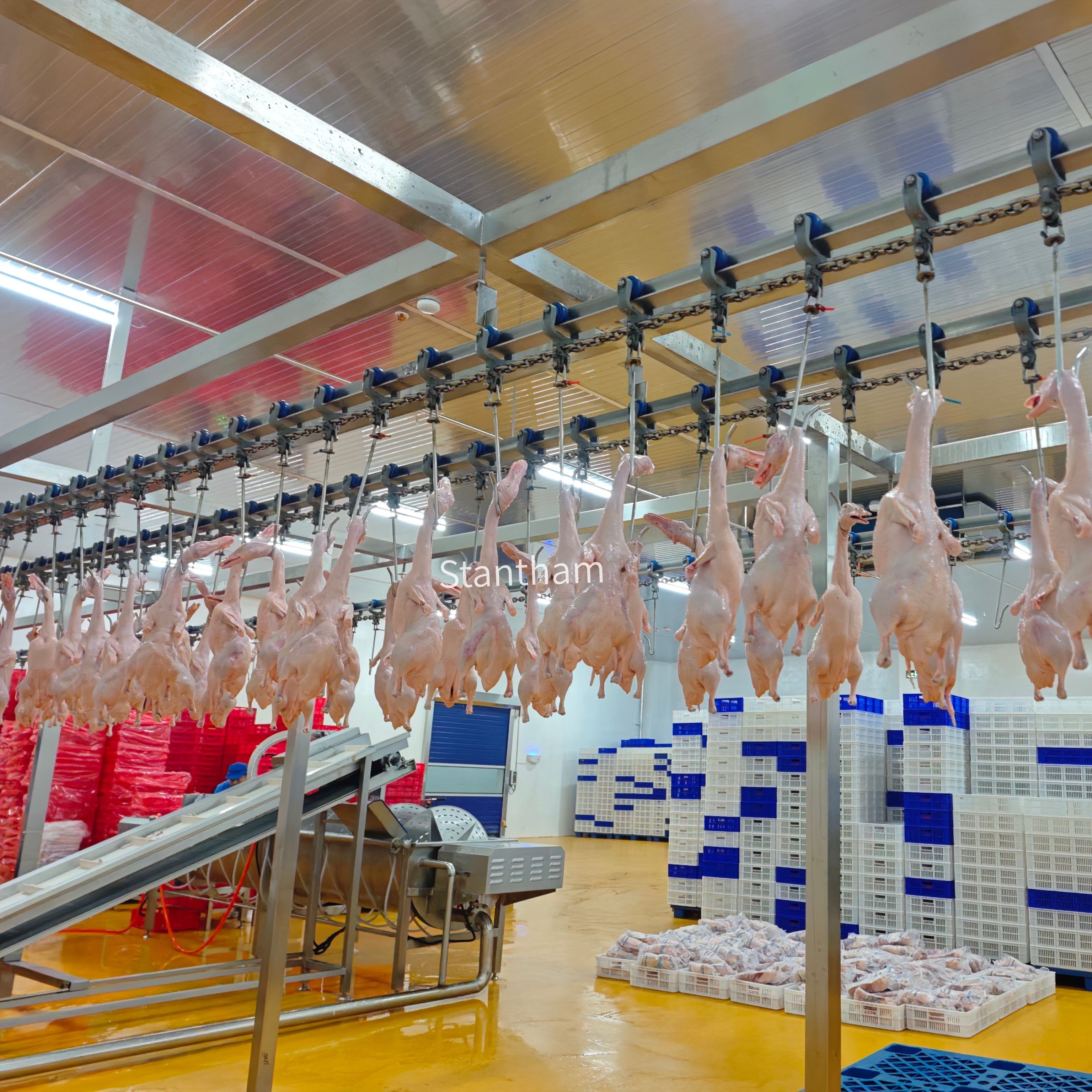
Turnkey adoption flips this dynamic. One engineering team owns the entire flow from crate to chill room. That means the overhead conveyor, the stunner, the scalding machine, the pluckers, and the evisceration line are designed to work together from day one. The integration risk shifts from the plant floor to the supplier's drawing board, where it belongs.
The Capacity Question That Changes Everything
Before signing anything, the real work begins with a single number: desired throughput. A 500-birds-per-hour line looks completely different from a 3,000-BPH operation. The equipment sizing, the building footprint, the wastewater treatment capacity, and even the cold storage requirements all scale non-linearly with that number.
A medium-scale operation targeting around 1,500 to 2,000 birds per hour might spec a line with automatic temperature-controlled scalding, A-type vertical feather pluckers, and a spiral chiller for rapid carcass cooling. Jump to 3,000 BPH and the equation changes—multiple pluckers in sequence, larger-capacity chillers, and a more sophisticated evisceration conveyor system become non-negotiable.
Here is where many projects go off the rails. Throughput targets get set without accounting for shift structure, maintenance windows, or the reality of bird delivery schedules. A line rated for 3,000 BPH that runs for only six hours a day because birds arrive in batches is a line that's grossly overcapitalized. The adoption process has to start with honest production planning, not optimistic brochure numbers.
Site Preparation and the Hidden Timeline
Once the capacity is locked, the next phase is site preparation—and this is where the timeline often stretches beyond initial estimates. A turnkey supplier typically provides layout drawings that show equipment footprints, utility connection points, and material flow paths. But translating those drawings into a ready facility involves electrical work, water supply lines, drainage, ventilation, and often structural modifications.
The electrical load for a poultry processing line is substantial. Scalding machines draw significant power for heating water. The overhead conveyor system needs variable-frequency drives. The chilling system, whether a screw chiller or a continuous immersion cooler, requires three-phase power and dedicated circuits. Water supply is equally critical—scalding, cleaning, and chilling all demand high volumes with specific temperature and pressure characteristics.
Drainage deserves special attention. A slaughterhouse generates a lot of wastewater with high organic load. The turnkey package usually includes the processing equipment but may not cover the wastewater treatment system. That's a separate procurement that needs to run in parallel with the main line installation. Waiting until the equipment is on-site to figure out the drainage capacity is a mistake that shows up in the first week of operation.
Installation, Integration, and the First Birds
Equipment delivery marks the transition from planning to doing. A turnkey project typically includes on-site installation support from the supplier's engineers. This is not the time to cut corners. Having the same team that designed the system handle the installation ensures that alignment tolerances, conveyor tracking, and control system integration happen correctly the first time.
The overhead conveyor deserves particular focus during installation. It's the backbone of the entire line, carrying birds from the hanging area through stunning, bleeding, scalding, plucking, evisceration, and finally to chilling. If the conveyor chain tension is wrong or the shackle spacing doesn't match the downstream equipment timing, the whole line stumbles.
Commissioning starts with empty runs—checking that motors start, conveyors move, and sensors report correctly. Then come the first birds. This is where the theoretical line speed meets reality. A common practice is to start at roughly half of the target throughput and gradually increase as operators get comfortable with the equipment and the line balance gets dialed in. Some turnkey suppliers recommend running the first full shift at reduced speed, then ramping up over several days.
Training: The Most Overlooked Success Factor
A beautifully installed line is useless without people who know how to run it. Turnkey packages often include operator training as part of the scope, but the quality and depth of that training varies widely. The best approach is to insist on hands-on training during the commissioning phase, with operators actually running the equipment under the supplier's supervision.
The training needs to cover more than just pushing buttons. Operators should understand the interdependencies between stations. If the scalder temperature drifts, how does that affect the plucker performance? If the evisceration conveyor speeds up, what happens to the inspection station downstream? This systems thinking is what separates a line that runs smoothly from one that constantly struggles.
Maintenance training is equally important. A poultry processing line has many moving parts: chains, bearings, motors, pumps, and heating elements. Knowing the preventive maintenance schedule, the common failure modes, and the quick fixes that keep production going during a shift makes the difference between a minor hiccup and a costly shutdown.
The Operational Reality Check
After the training wraps and the line goes into full production, the real adoption process begins. The first few weeks are about finding the operating sweet spot—the balance between throughput, product quality, and equipment reliability that works for the specific facility.
Some operators find that the theoretical line speed is achievable but requires more aggressive maintenance than anticipated. Others discover that bird size variability from their supplier means the evisceration equipment needs frequent adjustment. These are not failures of the turnkey approach. They are the normal growing pains of any new processing line. The advantage of a turnkey solution is that there's a single supplier to call when something isn't working right, rather than playing the blame game between multiple equipment vendors.
The USDA's Food Safety and Inspection Service requires that all poultry be processed under sound sanitary standards, with both ante-mortem and post-mortem inspections. Under the New Poultry Inspection System, young chicken establishments may operate at line speeds up to 175 birds per minute, provided they maintain process control. This regulatory context shapes how the line is operated and how the turnkey system must support inspection access and sanitation protocols.
Making the Turnkey Decision Stick
Adopting a turnkey slaughterhouse solution is not a transaction. It's a partnership that extends from the first site visit through installation, training, and the early months of operation. The operations that get it right are the ones that treat the supplier as an extension of their own engineering team rather than as a vendor to be managed at arm's length.
The turnkey model works because it aligns incentives. The supplier's reputation depends on the line performing as specified. That creates a powerful motivation to get the design right, the installation clean, and the training thorough. For the plant operator, the benefit is a single throat to choke—one point of contact for everything from conveyor alignment to control system tweaks.
The step-by-step adoption process—capacity planning, site preparation, installation, commissioning, training, and operational ramp-up—takes time and patience. But the alternative, piecemeal equipment procurement and integration, takes more time and produces worse results. The choice, for most operations, is clear.