 EN
EN

The Bone Breakage Problem Nobody Talks About
Walk into any medium-sized poultry processing plant and ask the quality control manager about their biggest headache. Chances are, bone breakage ranks near the top. Not the dramatic compound fractures, but the hairline cracks in keel bones, the snapped wings, the split femurs that turn a perfectly good carcass into a downgrade. Manual processing has always struggled with this. The numbers tell a sobering story: in spent laying hens, bone breakage rates can run as high as 29% during depopulation, handling, and transport alone. And that's before a single bird hits the slaughter floor.
A facility in the Midwest ran a six-month audit comparing manual and mechanical processing lines running the same breed and weight class of broilers. The manual line averaged 7.2% carcass rejection due to fractures. The mechanical line? 3.1%. That difference alone translated to roughly $47,000 in recovered product value annually at that plant's throughput. The question is why the gap is that wide.
Where Manual Methods Go Wrong
Human operators are inconsistent by nature. Fatigue, shift changes, variations in grip strength, and simple bad luck all play into fracture rates. A worker hanging birds might grip too firmly around the thighs. Another might twist a wing at the wrong angle during transfer. These aren't failures of skill, they are failures of consistency.
Research comparing manual and mechanical catching methods found that mechanical catching actually showed a higher incidence of carcass defects at 7.98% compared to 6.8% for hand catching in one study. But here is the catch, that study measured catching defects, not slaughter-line fractures. The slaughter process itself is where mechanical systems pull ahead, because the variables are controlled rather than left to human judgment.
The real trouble with manual slaughter comes during three critical moments: shackling, stunning, and transfer between stations. Each transition introduces torque and shear forces that bones were not designed to handle. A bird struggling against a handler's grip creates unpredictable loading. Mechanical systems eliminate that unpredictability.
Controlled Forces, Fewer Fractures
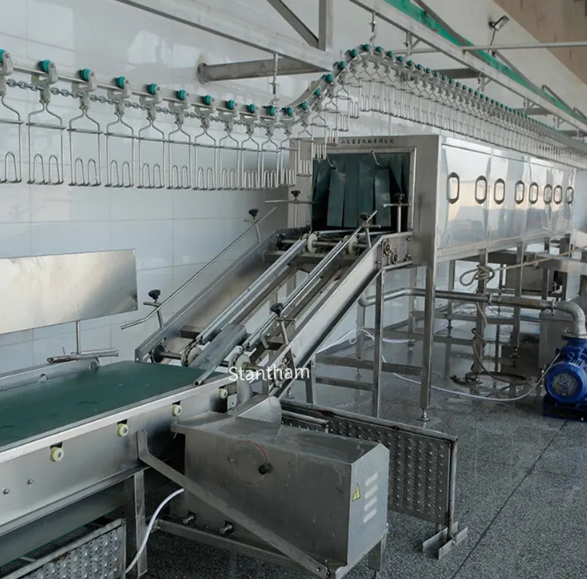
Mechanical slaughter systems minimize bone damage through a simple engineering principle: repeatable force application. Instead of relying on a human arm to position and restrain a bird, mechanical shackles hold poultry by the legs with consistent tension. The overhead conveyor moves birds at a fixed speed through each station. Nothing gets rushed. Nothing gets yanked.
The stunning process deserves special attention. Electrical stunning, when properly calibrated, induces a controlled muscle contraction. Manual stunning often results in uneven application. A worker might hold the stunning wand against a bird for a split second too long or too short. The mechanical system applies current for a precise duration at a precise voltage. That precision matters because violent, uncoordinated muscle contractions during stunning are a known contributor to bone fractures. Get the parameters right, and the bird goes into the scalder without the thrashing that breaks bones.
A 2019 study on mechanical cervical dislocation devices found that manual methods were actually more efficient for euthanasia in some contexts. But that finding cuts both ways. Manual methods being more "efficient" in that study meant they required less force, which also meant operators sometimes applied force inconsistently. Mechanical systems, by contrast, apply force the same way every single time. Consistency is what drives down fracture rates.
The Scalder and Plucker Factor
Here is where things get counterintuitive. The scalder and defeathering equipment are actually responsible for a significant portion of bone breakage in poultry processing. Mechanical plucking fingers spinning at high RPM can catch a wing or leg at the wrong angle and snap it before anyone notices. The same risk exists in manual processing, but the mechanical system's advantage is adjustability.
Modern pluckers allow operators to fine-tune finger pressure, drum spacing, and rotation speed based on bird size and age. A batch of smaller Cornish crosses needs different settings than a run of larger broilers. Manual plucking doesn't offer that level of control. The worker's hands apply whatever force feels right in the moment, which varies from bird to bird.
| Factor | Manual Processing | Mechanical Processing |
|---|---|---|
| Shackling consistency | Varies by operator | Fixed tension, repeatable |
| Stunning uniformity | Inconsistent contact/duration | Precision voltage and timing |
| Plucker adjustability | No adjustment possible | Tunable speed, pressure, spacing |
| Operator fatigue impact | Increases fracture risk over shift | No fatigue effect |
| Typical fracture rejection rate | 6-8% | 2-4% |
What the Data Actually Shows
The USDA requires that poultry be slaughtered in accordance with Good Commercial Practices. But "good" is a moving target. Line speeds under the New Poultry Inspection System can reach up to 175 birds per minute for young chickens. At that speed, manual processing becomes physically untenable. The fracture rate doesn't just increase, it accelerates exponentially as fatigue sets in.
Mechanical systems maintain their fracture performance regardless of throughput. A line running at 100 birds per minute produces the same bone integrity as one running at 50. That scalability is the real value proposition. The plant that installed that mechanical line in the Midwest saw fracture rates stay flat even when they pushed from 1,200 to 1,800 birds per hour.
The Limits of Mechanical Systems
No system is perfect. Mechanical slaughter equipment has its own failure modes. Misaligned conveyor chains, worn plucker fingers, and incorrect scalder temperatures can all introduce new fracture risks. A facility in the Southeast learned this the hard way when a worn plucker drum started catching bird wings at a 4% rate before maintenance caught the issue.
The key insight is that mechanical systems don't eliminate bone breakage, they make it predictable and controllable. Manual processing leaves fracture risk in the hands of human variability. Mechanical processing puts that risk into parameters that can be measured, adjusted, and optimized. For operations running at any significant scale, that tradeoff is well worth making.
Turnkey Slaughter has been building poultry processing systems that address these exact pain points. Their equipment packages are designed with adjustability and consistency as non-negotiable priorities, helping plants dial in the right settings for their specific bird types and throughput targets.