 EN
EN

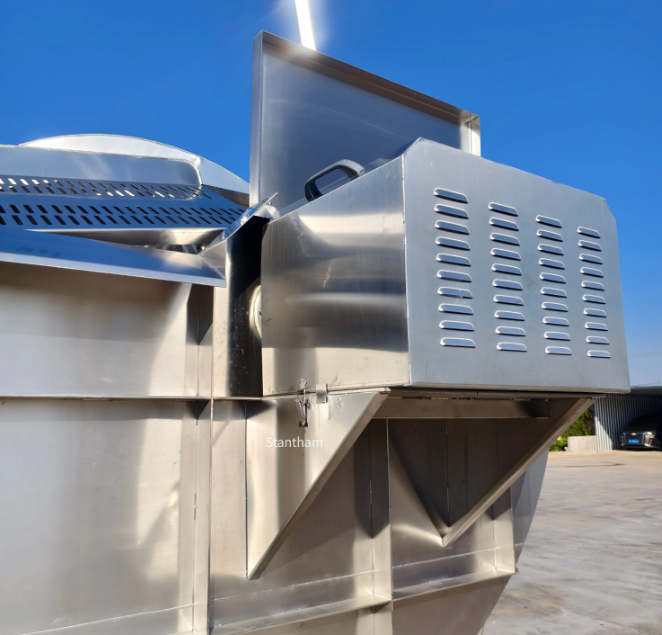
Understanding What a Poultry Chiller Actually Does
A poultry chiller machine is not simply a cold water tank. It is a controlled thermal exchange system designed to bring freshly eviscerated carcasses from roughly thirty-five degrees Celsius down to a safe holding temperature below four degrees Celsius in a defined time window. The process combines cold water or air with precise residence time control. In an immersion chiller, counterflow water movement ensures that the cleanest, coldest water contacts the birds just before they exit, while the dirtier, warmer water leaves at the intake end. This design principle, often called reverse flow, is what makes a properly engineered chiller a food safety tool rather than just a cooling device.
In air-chill systems, refrigerated air circulates through a tunnel or chamber, cooling carcasses by convection and evaporative surface moisture loss. Neither method is universally superior. Water immersion chilling typically cools faster and yields a slightly higher finished product weight due to water uptake, which strict regulatory limits cap at a defined percentage of carcass weight. Air chilling avoids that water uptake, producing a drier skin that some premium markets favor, but it takes longer and consumes more floor space per bird. The choice between them depends on product specification, customer expectations, and plant layout constraints.
Signs That Your Current Chilling Setup Is Holding You Back
Many processing facilities, especially older ones, chill birds in static ice-water tanks or batch immersion vats that were designed for volumes half their current throughput. Telltale signs of an undersized or inadequate chilling system include carcass core temperatures still above seven degrees Celsius sixty minutes after the start of chilling, high bacterial counts on neck skin samples taken at the post-chill checkpoint, and visible water quality degradation that forces frequent batch dumps.
Another indicator is labor cost. If a crew member needs to manually stir tanks, drag baskets between compartments, or constantly monitor and top up ice, the facility is leaking money and consistency at the same time. A continuous immersion chiller or a properly sized air-chill tunnel automates these steps, replacing variable human decisions with repeatable mechanical control. For a plant processing five thousand birds per day, recovering the labor hours spent on manual chilling can offset a significant fraction of the equipment investment within the first year, even before accounting for yield and shelf-life improvements.
Water Management and Its Impact on Product Quality
Water in an immersion chiller is not just a cooling medium. It is a shared bath that can spread contamination if not managed correctly. The makeup water volume, typically between one and two liters per carcass, serves both to replace heat-carrying water and to dilute the organic and microbial load. Regulations in many jurisdictions require a minimum fresh water inflow rate tied to throughput, and that rate is not a suggestion. It is a scientifically derived parameter to keep aerobic plate counts and potential pathogen levels within safe bounds.
A look at the numbers across three chiller configurations makes the differences clear. A static ice-water tank uses roughly 0.5 to 1.0 liters of fresh water per carcass. It usually brings the outlet temperature down to somewhere between 6 and 10 degrees Celsius, with a water uptake of 2 to 4 percent. Microbial control depends almost entirely on frequent batch dumps, which waste water and interrupt production. A continuous immersion system with reverse flow, by contrast, consumes 1.5 to 2.5 liters of fresh water per bird, yet achieves a much lower outlet temperature of 2 to 4 degrees Celsius. Water uptake runs higher at 4 to 8 percent, a range that regulations strictly cap. Hygiene is maintained through continuous dilution and the dosing of chlorine or peracetic acid, which keeps aerobic plate counts low over extended runs. An air chill tunnel uses no process water at all, so there is no water uptake. Outlet temperatures typically land between 3 and 5 degrees Celsius. The dry surface eliminates waterborne cross-contact, which is the primary microbial control advantage of air chilling. Each approach has its own hygiene, yield, and cost profile, and none solves every problem by itself.
A Practical Example: Converting a Batch Chilling Room in a Duck Plant
A duck processing plant in East China had been using three open-top batch chilling tanks, each holding roughly one hundred carcasses per cycle. As the plant scaled from eight hundred to two thousand ducks per day, the chilling step became the bottleneck. Core temperatures after chilling were inconsistent, ranging from three to eight degrees Celsius. The plant also battled periodic regulatory write-ups for exceeding water uptake limits, because operators compensated for slow cooling by leaving birds in the tank too long.
The solution was a continuous immersion screw chiller paired with a post-chill air-blast spiral. Water temperature was maintained at zero-point-five to one degree Celsius using an external glycol chiller. The screw speed was calibrated to deliver a residence time of thirty-two minutes for a two-point-five-kilogram duck carcass. Within two weeks of commissioning, core temperatures stabilized at one-point-five to two degrees Celsius across all birds sampled. Water uptake dropped to within the legal limit, and the post-chill neck skin total plate count fell by over seventy percent compared to the batch system average. The plant also freed up sixteen square meters of floor space previously occupied by the third tank, which was then used to expand the cut-up area, a compounding benefit that batch-chilling had been hiding.
When a Poultry Chiller Machine Might Not Be the Answer
Despite the advantages, a dedicated chiller machine is not the right fit for every facility. A very small operation processing fewer than three hundred birds a day may find that a well-managed static ice slush system, combined with immediate cold storage transfer, delivers acceptable results at a fraction of the capital cost. A plant that exclusively supplies a cooked product line where the meat goes directly into a cooking kettle within an hour of slaughter has less stringent chilling requirements than a plant producing fresh tray-packed retail cuts with a fourteen-day shelf-life target.
Facilities with severely limited access to consistent, high-volume potable water may also struggle to operate an immersion chiller within regulatory standards. In such cases, an air-chill system or even a phased upgrade starting with a pre-chiller tank followed by a blast air room can be a more pragmatic path. The key is to match the technology to the actual thermal load, hygiene requirement, and product destination, not to install a chiller simply because a competitor has one.
The Manufacturing Quality Behind Long-Term Chiller Reliability
A poultry chiller machine represents a significant capital expense, and its working life should span at least a decade under daily production conditions. The difference between a chiller that runs trouble-free for fifteen years and one that develops leaking welds, jammed augers, and failed bearings in year three often comes down to material specifications and fabrication discipline. All product-contact surfaces must be 304 stainless steel with verified nickel content to resist the corrosive combination of chlorinated water, organic acids, and constant mechanical abrasion from carcass movement. Stantham, as a direct manufacturer, applies incoming material inspection with a SPECTRO analyzer to confirm that every sheet of stainless meets that standard before it enters the fabrication shop. For a chiller operating sixteen hours a day in a wet, cold environment, that level of material integrity is not a luxury, it is the foundation of food safety and operational uptime.
Table of Contents
- Understanding What a Poultry Chiller Actually Does
- Signs That Your Current Chilling Setup Is Holding You Back
- Water Management and Its Impact on Product Quality
- A Practical Example: Converting a Batch Chilling Room in a Duck Plant
- When a Poultry Chiller Machine Might Not Be the Answer
- The Manufacturing Quality Behind Long-Term Chiller Reliability