 EN
EN

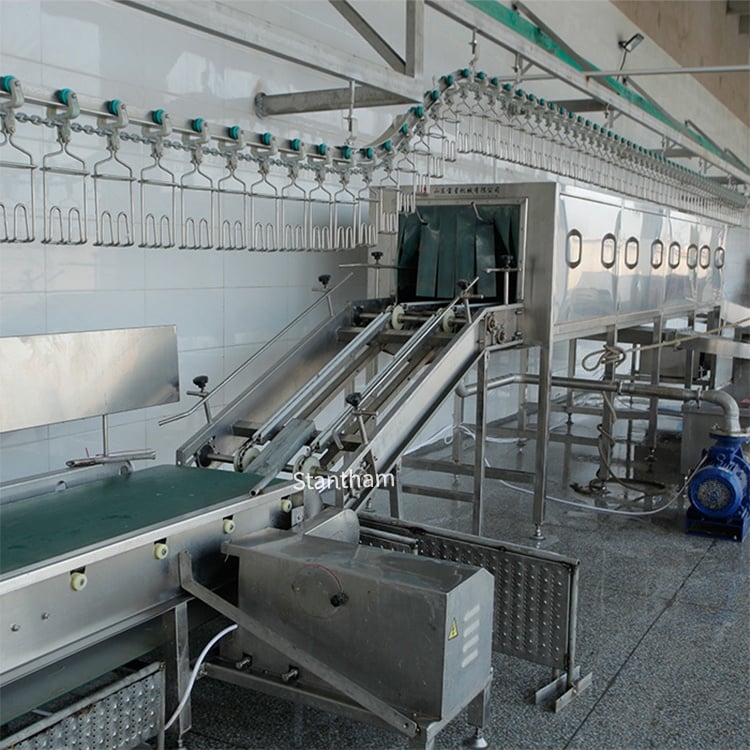
The Bleeding Tunnel: More Than Just a Conveyor
Walk into any medium-to-large poultry processing facility, and the bleeding section tells a story about the operation's overall discipline. Some plants run tight, clean lines where carcasses move through with minimal mess and maximum yield. Others have blood pooling on the floor, workers hosing down between every shackle, and a noticeable drop in final product quality. The difference often comes down to one piece of equipment: the bleeding tunnel.
A bleeding tunnel isn't just a covered conveyor that moves birds from the killing station to the scalder. It's a controlled environment where gravity, timing, and tunnel geometry work together to do one thing well—get blood out of the carcass as completely and cleanly as possible. When the tunnel is designed with integrated blood collection features, the efficiency gains show up everywhere: better meat quality, lower cleanup costs, and fewer rejects at the inspection station.
What Actually Happens Inside a Bleeding Tunnel
The physics are straightforward but unforgiving. After the throat is cut, the bird needs time to bleed out before entering the scalder. Industry research shows that approximately 45 percent of a chicken's total blood volume—roughly 3 percent of its live weight—drains during the bleed-out phase. The critical window is the first 90 seconds, during which 73 to 77 percent of all blood loss occurs. Beyond that point, only about 8 to 9 percent of total blood loss happens after the 90-second mark.
That means the tunnel length and conveyor speed have to be precisely matched to the line's throughput. A tunnel that's too short forces birds into the scalder before they've fully bled out. Blood remaining in the carcass coagulates in the scald water, creating a sticky residue that's difficult to remove and affects skin color and shelf life. A tunnel that's too long, on the other hand, wastes floor space and can cause the birds to start cooling before they hit the scalder, which throws off the entire thermal processing curve.
How Integrated Design Changes the Game
A properly integrated bleeding tunnel does three things that a basic open conveyor can't match:
-
Contained blood flow – The tunnel floor is sloped toward a central collection trough, channeling blood directly to a sump instead of letting it spread across the plant floor. This isn't a minor convenience; it cuts slaughter-area cleanup labor by roughly half and keeps blood from splashing onto evisceration equipment downstream.
-
Controlled drainage angle – The birds hang at a specific angle that encourages blood to flow out of the neck cavity rather than pooling in the chest cavity. A 15-to-20-degree forward tilt is common in well-designed systems, though the optimal angle varies with bird size and breed.
-
Timing precision – Variable-speed drives on the tunnel conveyor allow operators to dial in the exact dwell time for their specific throughput. If the line is running 6,000 birds per hour, the tunnel speed adjusts to maintain that 90-second window. Drop to 4,000 birds per hour for a specialty run, and the speed changes accordingly.
One processor in the Midwest ran into persistent quality issues with a 20-year-old open bleeding section. Dark spots on breast meat, inconsistent shelf life, and high bacteria counts in the chiller were traced back to incomplete bleeding. After retrofitting an integrated tunnel with sloped collection floors and variable-speed control, the plant saw measurable improvements in carcass appearance within the first week. The operations manager noted that the real win wasn't just the cleaner meat—it was the fact that the evisceration crew stopped having to stop the line to clean blood off the inspection table.
The Numbers That Matter
Here's what the data looks like when comparing a basic open bleeding setup against an integrated tunnel system. These figures come from a composite of facility audits conducted across multiple plants processing between 4,000 and 8,000 birds per hour.
| Performance Metric | Open Bleeding Setup | Integrated Tunnel System |
|---|---|---|
| Blood volume drained (as % of live weight) | 2.1–2.5% | 2.8–3.1% |
| Carcass discoloration rate | 4–7% | 1–2% |
| Slaughter area cleanup time (man-hours per shift) | 2.5–3.0 | 1.0–1.5 |
| Blood contamination on evisceration equipment | Frequent | Rare |
The yield difference alone—roughly 0.5 to 0.7 percent of live weight in additional blood removal—translates into real product value when scaled across hundreds of thousands of birds per week.
Where the Limitations Start
No piece of equipment is a silver bullet, and the integrated bleeding tunnel has its constraints. Bird size matters. A tunnel optimized for 2.5-kg broilers won't perform the same way with 4-kg roasters. The neck cut placement and depth also play a huge role—no tunnel can compensate for a sloppy kill. If the carotid arteries and jugular veins aren't properly severed, blood simply won't drain regardless of how well the tunnel is designed.
There's also the question of facility layout. Retrofitting an integrated tunnel into an existing plant often requires reconfiguring the overhead conveyor system, which can mean days of downtime. For new builds, the integration is straightforward. For older facilities, the ROI calculation needs to factor in the installation disruption.
The Bottom Line on Blood Drainage
An integrated bleeding tunnel improves blood drainage efficiency by creating a controlled, repeatable environment where timing and gravity work in concert. The gains aren't theoretical—they show up as better color, longer shelf life, lower cleanup costs, and fewer headaches for the evisceration crew. But the equipment is only as good as the process around it. Proper stunning, accurate neck cutting, and consistent line speed are non-negotiable prerequisites.
For operations looking to upgrade or build new, the choice isn't whether to have a bleeding tunnel—it's whether to have one designed with integrated collection features or settle for a basic open system that leaves money on the floor, literally and figuratively. Companies like Shandong Chengming Shun Smart Equipment Co., Ltd. have been building these systems with food-grade materials and precision engineering that match the demands of modern processing lines, offering configurations that fit everything from compact startups to high-volume industrial facilities.