 EN
EN
The Real Cost of Leaving Meat on the Bone
Every processing manager knows the sinking feeling of watching trimmed meat go down the waste chute. That pinkish-red stream represents not just lost product but lost margin. In poultry processing, yield isn't just a metric, it's the difference between a profitable shift and one that barely breaks even. The numbers bear this out. Industry analysis suggests that even modest improvements in yield, on the order of a few grams per bird, can translate into substantial annual gains for a medium-volume facility.
The challenge lies in the cutting room. Manual cutting, while flexible, introduces variability that no amount of operator training can fully eliminate. One cutter's interpretation of "clean cut" differs from the next, and fatigue compounds the issue as shifts wear on. Mechanical cutting equipment addresses this variability head-on, but not all machines deliver the same results.
Where Traditional Cutting Methods Fall Short
Conventional cutting approaches, whether manual or using older mechanical systems, share a common weakness: they treat every bird the same. Anyone who's spent time on a processing floor knows that bird sizes vary, sometimes considerably, within a single flock. Fixed cutting paths don't account for these differences, which means smaller birds get over-trimmed and larger birds leave valuable meat behind.
The financial impact adds up quickly. Research from Georgia Tech suggests that leaving just five grams of meat on the carcass per bird costs a processing plant roughly $1.5 million annually. That's not a theoretical number, it's real money walking out the door every day.
Manual methods introduce another problem: inconsistency in cut placement. A cut that's off by a few millimeters might not seem significant, but across thousands of birds, those millimeters represent pounds of recoverable meat. Mechanical systems with precision positioning capabilities eliminate this guesswork, delivering repeatable cuts that manual operators simply cannot match shift after shift.
How Modern Equipment Captures More Value
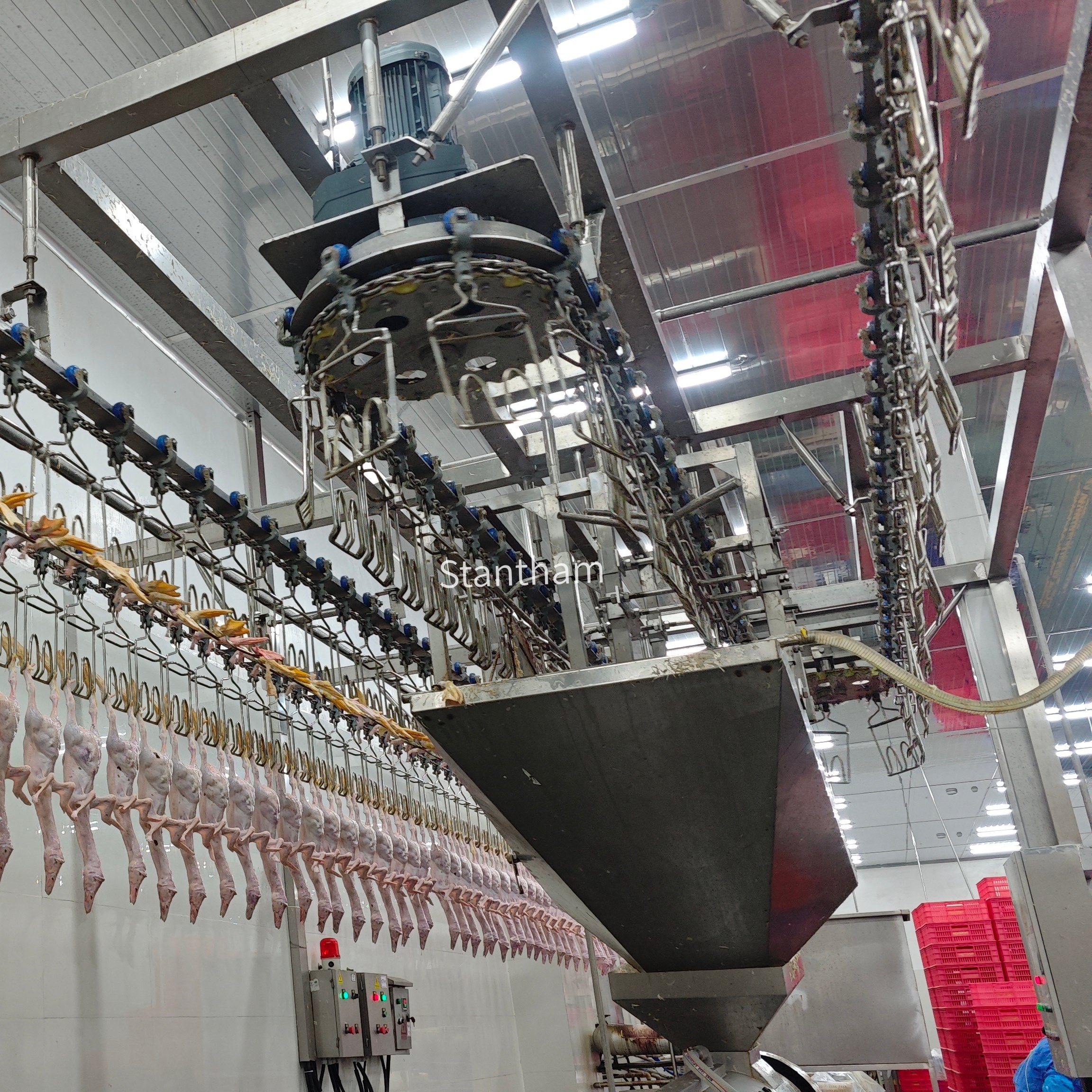
The evolution of poultry cutting equipment has focused on one central question: how to extract every usable gram from each bird without compromising food safety or product quality. Recent advances in automation have produced systems that can adapt to individual bird characteristics in real time.
Take breast deboning, for instance. Advanced systems now use measurement technology to assess each breast's size and shape before cutting, adjusting the cutting path accordingly. This individual approach contrasts sharply with older systems that applied the same cut to every bird. The yield improvements from this adaptive approach have been documented in field trials, with some operations reporting per-fillet gains that add up to hundreds of tons of additional meat annually.
Similarly, wishbone removal has seen significant innovation. Patented four-blade principles automatically adjust to each bird's anatomy, recovering meat that older systems left behind. Self-adjusting scrapers follow natural product contours, reducing meat loss while minimizing the need for daily recalibration.
A Case from the Field
A midsize poultry processor in the Midwest had been running a mix of manual cutting stations and older mechanical equipment for years. The operation processed roughly 80,000 birds per day across two shifts. Yield had plateaued, and the quality control team was flagging an increasing number of cuts that required rework.
The plant brought in a consultant to evaluate the cutting room. The findings were telling. Manual stations showed yield variation of up to 8 percent between operators on the same product. The older mechanical cutter, while more consistent, was leaving an average of 6 grams of breast meat on the frame, meat that could have been recovered with more precise equipment.
After installing updated cutting equipment with adaptive measurement and precision positioning, the plant saw a measurable improvement. The variation between stations dropped significantly, and the per-bird yield increased enough that the equipment paid for itself within the first year of operation. The plant manager noted that the real win wasn't just the extra meat, it was the predictability. Production planning became more reliable when yield stopped fluctuating with operator skill and fatigue.
The Technology Behind Better Yields
Understanding what makes modern cutting equipment effective requires looking at a few key engineering choices.
The measurement capability deserves special attention. Systems that can assess each bird individually and adjust cutting trajectories accordingly represent a fundamental shift from the one-size-fits-all approach. This isn't just about adding sensors; it's about using that data to make real-time decisions that affect every cut.
Matching Equipment to Operation Scale
Not every processing facility needs the same level of automation. A small operation processing a few hundred birds per hour has different requirements than a high-throughput plant running tens of thousands per shift. The key is matching equipment capability to operational reality.
For smaller facilities, compact cutting lines with basic automation can deliver meaningful improvements over manual cutting without the capital outlay of full-scale systems. These solutions typically feature simplified adjustment mechanisms and straightforward maintenance procedures, making them practical for operations without dedicated engineering staff.
Larger operations benefit from fully integrated systems with advanced measurement and adaptive cutting. The upfront investment is higher, but the per-bird yield improvements scale with volume, making the return calculation more favorable at higher throughputs.
The sweet spot for many operations lies somewhere in the middle: equipment that offers precision cutting and basic adaptability without the complexity of full AI-driven systems. This approach delivers the majority of the yield benefit at a fraction of the cost.
Practical Considerations for Upgrade Decisions
When evaluating cutting equipment upgrades, several factors beyond raw yield deserve attention.
Maintenance requirements vary significantly between equipment types. Systems with fewer moving parts and simplified mechanical drives tend to have lower ongoing costs and less downtime. Cleaning time is another consideration, equipment designed with hygienic principles and integrated rinsing systems can reduce sanitation labor significantly.
Operator training requirements also matter. Equipment that requires extensive training or specialized skills to operate effectively can create bottlenecks, especially in facilities with high turnover. Systems designed with intuitive controls and straightforward adjustment procedures reduce this risk.
Food safety compliance is non-negotiable. Equipment constructed from food-grade materials, particularly 304 stainless steel, supports sanitation protocols and helps facilities pass audits. The material choice also affects long-term durability, with stainless steel offering superior corrosion resistance compared to carbon steel alternatives.
The Bottom Line on Meat Yield
Maximizing meat yield isn't about chasing the last fraction of a percent at any cost. It's about understanding where value is being left on the table and making targeted investments to capture it. For many operations, the most impactful improvements come from upgrading cutting equipment to systems with individual product measurement and adaptive cutting capabilities. The yield gains, combined with reduced variability and lower rework, typically deliver returns that justify the investment.
Companies like Stantham have built their reputation on providing processing equipment that helps operations achieve these yield improvements without overcomplicating the production floor. Their focus on food-grade materials, durable construction, and practical automation reflects the real-world needs of poultry processors who need equipment that works shift after shift, year after year.
Table of Contents
- The Real Cost of Leaving Meat on the Bone
- Where Traditional Cutting Methods Fall Short
- How Modern Equipment Captures More Value
- A Case from the Field
- The Technology Behind Better Yields
- Matching Equipment to Operation Scale
- Practical Considerations for Upgrade Decisions
- The Bottom Line on Meat Yield