 EN

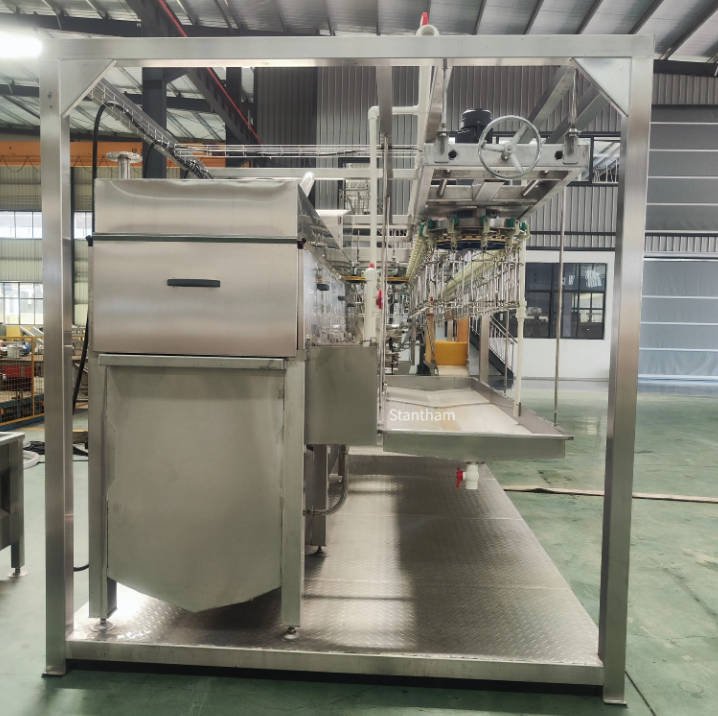
Throughput Gains: How Automatic Chicken Slaughter Equipment Line Doubles Processing Capacity
Automation transforms poultry processing from a labor‑dependent choreography into a tightly synchronized, high‑speed operation. A fully integrated automatic chicken slaughter equipment line eliminates intermediate hold‑ups and manual transfer steps, enabling throughput that far exceeds what semi‑automatic or hand‑assisted setups can achieve. The following subsections examine the core mechanisms behind this capacity leap.
Quantified speed advantage: 300–600 vs. 120–250 birds/hour
Facilities relying on manual shackling, batch scalding, and operator‑paced evisceration typically process 120 to 250 birds per hour. Switching to a sequenced automatic chicken slaughter line pushes that range to 300–600 birds per hour—effectively doubling usable capacity (Poultry Processing Performance Review 2023). This gain stems not just from faster machines, but from uninterrupted flow: a high‑capacity eviscerator sustains 10–12 birds per minute when fed continuously, versus 4–6 birds per minute with frequent pauses due to clogging or fatigue. Continuous operation nearly eliminates the micro‑stoppages that fragment semi‑automatic cycles, yielding predictable, consistently higher hourly output.
Elimination of human-dependent bottlenecks via synchronized conveyor integration
In manual or semi‑automatic settings, productivity is constrained by the slowest station—often evisceration or hand-loaded scalding. Synchronized conveyors dissolve these choke points by integrating stunning, scalding, defeathering, evisceration, and chilling into one timed current. Each bird advances at a fixed pace, and machines perform tasks in parallel without waiting for operator input. This alignment compresses the per‑bird cycle dramatically: a documented mid‑size plant upgrade reduced cycle time from ~45 seconds (with idle gaps) to a sustained 22 seconds while cutting direct labor costs by ~40% (2023 Processing Plant Efficiency Study). Conveyor‑driven rhythm also prevents cumulative delays caused by upstream–downstream imbalances—delivering steady, pulse‑free output of 500–600 birds per hour without the production valleys common in operator‑dependent lines.
Precision and Consistency: Reduced Variability Through Automated Chicken Slaughter Equipment
Automation in poultry processing turns slaughtering from a craft of approximations into a discipline of repeatable, inch-perfect results. Where manual or semi‑automatic lines introduce drift at every touch‑point, intelligent chicken slaughter equipment enforces exact tolerances, ensuring every bird passes through identical process conditions.
Tighter weight deviation control: ±2% vs. ±12% in semi-automatic systems
Manual trimming and portioning create broad weight swings that erode yield and customer trust. With automatic chicken slaughter equipment, servo‑driven cutters and dynamic weighing cells hold final weight deviation to ±2%, a dramatic tightening from the ±12% typical in semi‑automatic setups (2023 Industry Performance Benchmarks). This precision eliminates costly give‑away and rework, directly raising margin per bird.
| Processing Mode | Typical Weight Deviation |
|---|---|
| Semi‑automatic (manual trimming) | ±12% |
| Fully automatic slaughter line | ±2% |
Sensor‑guided repeatability: real‑time adjustments for uniform evisceration, scalding, and chilling
Unseen variability in water temperature, mechanical force, or dwell time undermines consistency. Advanced vision and laser‑scanning modules now operate across all stations: during evisceration, sensor arrays detect cavity depth and adjust vacuum tools instantaneously; in scalding, multi‑point probes modulate tank temperature within 0.5 °C; and at chilling, flow‑rate algorithms maintain identical core‑cooling curves. A recent laser‑based machine vision study demonstrated breast portioning with a mean absolute error as low as 4.53%, and repeatability analysis showed total measurement variation under 10% (PeerJ 2023). The result is a steady stream of identically processed carcasses—free from the inconsistencies inherent in manual oversight.
Operational Efficiency: Closed-Loop Control and Real-Time Optimization in Automatic Chicken Slaughter Equipment
The hallmark of a modern automatic chicken slaughter equipment line is its ability to self-regulate through closed-loop control systems. Unlike fixed-cycle machinery that operates on preset timers regardless of real-world conditions, these intelligent systems continuously monitor critical variables and make instantaneous adjustments. Sensor arrays positioned throughout the line measure parameters such as scalding tank temperature, chilling water pH, and torque on evisceration tools, feeding data back to centralized programmable logic controllers. When deviations occur—a drop in scald water heat during high-throughput runs, for instance—the controller immediately modulates steam valves or conveyor speed to restore optimal parameters without manual intervention. This real-time optimization eliminates the lag inherent in human supervision, where an operator might only detect a fault after dozens of birds have already been processed incorrectly.
The operational impact extends directly to resource consumption and waste reduction. By fine-tuning motor speeds and water flow rates to match live bird weight variations or processing cadence, the line avoids the energy waste common in systems that run at full power continuously. For example, a leading manufacturer's integrated line demonstrated measurable reductions in electricity and water usage per carcass due to adaptive chilling and scalding control. This precision also minimizes over-processing—excessive feather removal force or extended evisceration contact that damages skin and reduces yield quality. The result is a self-correcting production environment where the interplay between sensors and actuators consistently aligns throughput capacity with resource input, transforming the slaughter line from a mere assembly sequence into a responsive, efficiency-maximizing system.
Regulatory Compliance and Quality Assurance Enabled by Automatic Chicken Slaughter Equipment
Automated traceability, HACCP-aligned monitoring, and audit-ready consistency
Automatic chicken slaughter equipment embeds compliance directly into the processing workflow. From live‑bird intake, integrated sensors track each carcass through stunning, scalding, evisceration, and chilling, creating an unbroken digital chain of custody. HACCP‑aligned monitoring continuously verifies critical limits—water temperature, dwell time, microbial counts—and generates immediate alerts if a parameter drifts. Instead of relying on paper logs prone to gaps or transcription errors, the system produces time‑stamped, audit‑ready reports that demonstrate consistent adherence to food‑safety regulations. The precise data enables quick root‑cause analysis during inspections, while immutable records sharply reduce the administrative burden of compliance verification. Automating these checks eliminates the variability of manual oversight and builds a proactive food‑safety culture. Ultimately, such traceability narrows recall scopes, protecting public health and a processor’s reputation.
Frequently Asked Questions (FAQ)
What throughput capacity improvements can automatic chicken slaughter equipment achieve?
Automatic chicken slaughter equipment lines can double processing capacity compared to semi-automatic setups, enabling rates of 300–600 birds per hour versus 120–250 birds per hour in manual methods.
How is weight deviation minimized with automatic poultry processing equipment?
Precision tools like servo-driven cutters and dynamic weighing cells hold weight deviation to ±2%, compared to ±12% seen in semi-automatic systems, leading to higher yield and customer trust.
What are synchronized conveyor systems, and how do they enhance productivity?
Synchronized conveyors integrate all processing tasks into a timed sequence, eliminating bottlenecks caused by manual interventions and ensuring pulse-free throughput for seamless operation.
How does automation improve regulatory compliance?
Automated systems track processing data in real time, aligning with HACCP standards and creating audit-ready records. This greatly reduces manual error and administrative workload while ensuring consistent food safety compliance.
Table of Contents
- Throughput Gains: How Automatic Chicken Slaughter Equipment Line Doubles Processing Capacity
- Precision and Consistency: Reduced Variability Through Automated Chicken Slaughter Equipment
- Operational Efficiency: Closed-Loop Control and Real-Time Optimization in Automatic Chicken Slaughter Equipment
- Regulatory Compliance and Quality Assurance Enabled by Automatic Chicken Slaughter Equipment
- Frequently Asked Questions (FAQ)