 EN

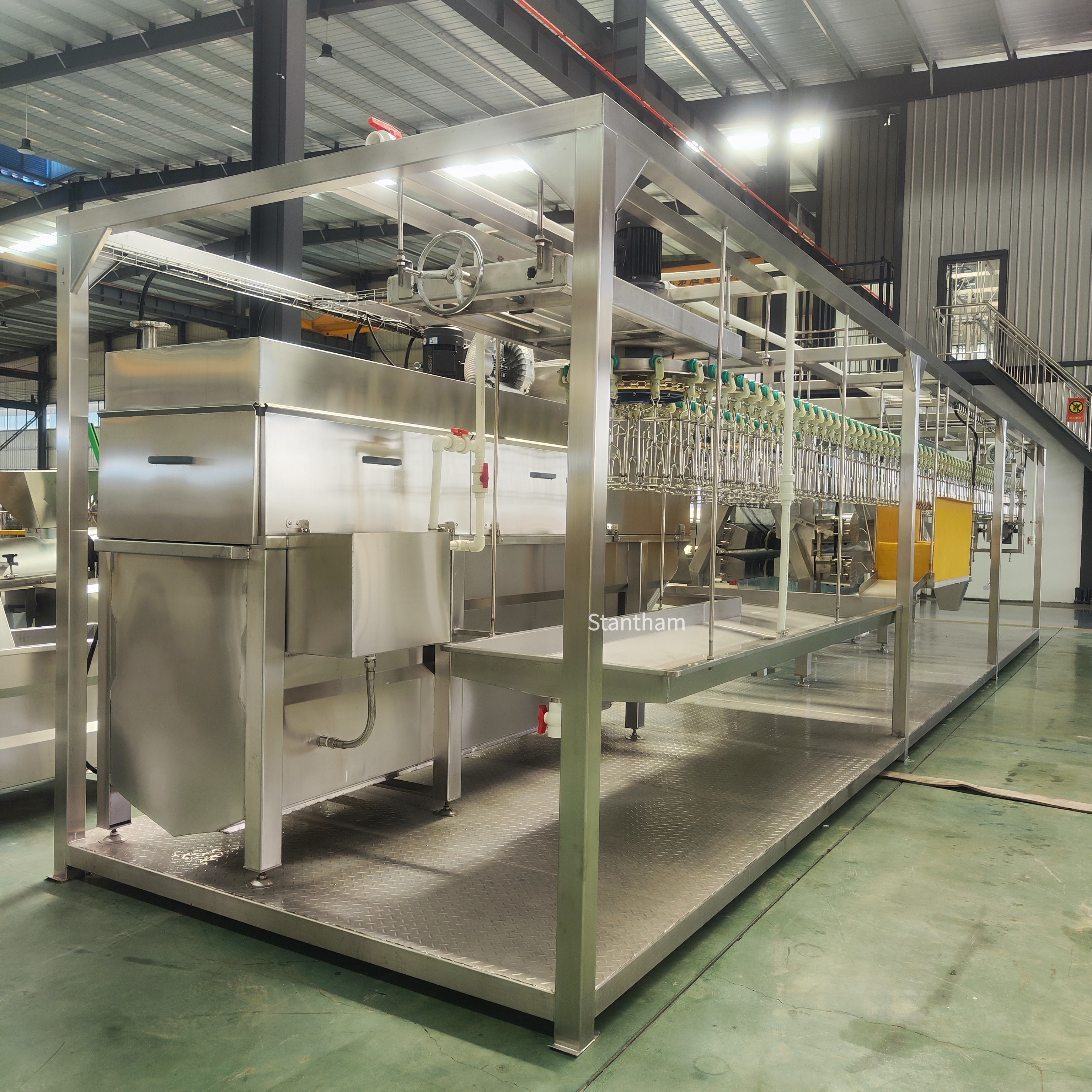
Engineering Controls: Guarding Systems for Chicken Slaughter Equipment
Fixed and Interlocked Guards to Prevent Entanglement and Amputation Hazards
Machinery guarding is the primary line of defense against severe mechanical hazards in chicken slaughter equipment. Per OSHA 1910.212, fixed guards must be securely attached to prevent any part of the body from reaching rotating shafts, chains, or cutting blades. Interlocked guards add a critical fail-safe: if opened or removed, they automatically cut power—stopping motion before exposure occurs. In high-speed poultry processing environments—especially near evisceration lines—interlocked systems reduce entanglement-related amputations by over 80% (Journal of Safety Research, 2022). The table below summarizes key selection factors for guard types on chicken slaughter equipment.
| Guard Type | Primary Advantage | Best Application in Chicken Slaughter |
|---|---|---|
| Fixed | Permanent, tamper-proof barrier; no moving parts | Shrouding drives of plucking machines, scalder conveyors |
| Interlocked | Shuts down equipment instantly when guard is opened | Access panels on automatic cutting saws, vent cutters |
| Adjustable | Accommodates varying product sizes while maintaining protection | In-feed chutes to neck breakers with manual adjustment |
Integrating these guards at points of operation and on power transmission systems not only protects personnel but also extends equipment service life by preventing debris ingress.
Line-of-Fire Mitigation at High-Speed Deheading and Evisceration Stations
Deheading and evisceration stations present distinct line-of-fire hazards—including impact from ejected parts and entrapment between tooling and birds. High-speed rotating blades in automatic neck cutters and evisceration wheels operate with significant kinetic energy. To mitigate these risks, facilities deploy polycarbonate shields that fully enclose the cutting zone, blocking flying debris while enabling visual monitoring. Light curtains or pressure-sensitive mats are integrated into the safety circuit to halt operation immediately if a worker enters the hazardous area—for example, a dual-channel safety light curtain at the mouth of an eviscerator can stop the cycle within 15 milliseconds. Fixed tunnel guards over downstream conveyors contain ejected heads and feathers, reducing slip and impact risks. Routine validation through documented lockout/tagout procedures ensures reliability; even momentary bypassing creates unacceptable risk. These engineering controls must withstand the relentless pace of high-volume chicken processing, where split-second lapses can lead to lost-time incidents.
Emergency Response and Energy Control on Chicken Slaughter Lines
Redundant, Accessible Emergency Stop Systems Across the Line
Every chicken slaughter line must integrate emergency stop (e-stop) buttons that are instantly reachable from every operator position. These controls follow a dual-channel, fail-safe design: if one circuit fails, the second still halts motion. E-stop buttons must be mounted at key hazard points—deheading machines, evisceration stations, and transfer belts—no more than 1 meter from the operator’s reach envelope. Color-coding (red actuator on yellow background) and standard mushroom-head shape ensure immediate recognition. Redundancy extends to control logic: safety relays continuously monitor the e-stop circuit and trigger an immediate Category 0 stop upon activation. Functional testing—at least monthly—verifies that each e-stop stops all hazardous movement within 0.1 second. Accessible placement and tactile, palm-sized actuators minimize fumbling under stress, directly improving response time during entrapment events.
OSHA-Compliant Lockout/Tagout Procedures for Multi-Station Chicken Slaughter Equipment
Lockout/tagout (LOTO) on multi-station chicken slaughter equipment follows OSHA 1910.147 to isolate all energy sources—electric, pneumatic, hydraulic, and kinetic—during maintenance. Each piece of equipment requires a documented procedure listing specific isolation points, step-by-step shutdown instructions, and verification steps. Because lines often share conveyors and common drives, group lockout is essential: a dedicated hasp accommodates personal locks from each authorized employee. After isolating power, stored energy must be safely dissipated—for instance, activating bleed valves on pneumatic clamps. A “try-out” step—where the operator attempts to restart the system—confirms zero energy remains. Training clearly distinguishes authorized employees (who perform LOTO) from affected workers (who follow warnings only). Annual audits compare written procedures to real-world execution, closing gaps that could otherwise lead to inadvertent startup and catastrophic injury.
Human-Centered Safety Integration: Risk Assessment and PPE Strategy
Proactive Hazard Identification Using JSA and HACCP-Aligned Risk Assessment
A Job Safety Analysis (JSA) breaks down each task on chicken slaughter equipment—from shackling to evisceration—to identify motion, energy, and ergonomic hazards. Integrating JSA with Hazard Analysis Critical Control Point (HACCP) principles adds biological and cross-contamination awareness unique to poultry processing. For example, high-speed blade stations require precise task sequencing because even a momentary lapse can result in entanglement or amputation. This dual review enables safety teams to address mechanical and hygiene hazards concurrently—eliminating redundant assessments. Structured risk matrices prioritize findings, directing resources to the highest-consequence exposures. Facilities embedding JSA into daily shift briefings consistently report increased near-miss reporting and reduced serious incident rates.
PPE as a Critical Layer—Not a Substitute—for Engineering Controls in Chicken Slaughter Equipment
Personal protective equipment (PPE) serves only as the final layer of protection—never a replacement—for robust engineering controls. Cut-resistant gloves and mesh aprons are essential on kill lines, but they must never substitute for fixed guarding, interlocked shields, or safe-distance barriers. Over-reliance on PPE masks uncontrolled hazards: expecting operators to endure splashes instead of installing enclosed evisceration units, for instance, invites long-term compliance erosion and elevated injury risk. Effective programs treat PPE as a reinforcing component within the full hierarchy of controls—anchored first by elimination, substitution, and engineering solutions.
Frequently Asked Questions (FAQ)
What is the main purpose of guarding systems on chicken slaughter equipment?
Guarding systems are designed to prevent severe mechanical hazards such as entanglement, amputation, and impact injuries by providing physical barriers and automatic shutoff mechanisms.
How do interlocked guards function in high-speed poultry processing?
Interlocked guards automatically shut down equipment when they are opened or removed, minimizing exposure to hazardous motion and significantly reducing injury risks such as amputations.
What are some examples of PPE used in chicken slaughter facilities?
Common examples include cut-resistant gloves and mesh aprons on kill lines. These items complement engineering controls but should never replace them.
Why is a Job Safety Analysis (JSA) important in poultry processing?
JSAs help identify potential motion, energy, ergonomic, and biological hazards for each task, enabling a proactive approach to risk mitigation and improved worker safety.
What is Lockout/Tagout (LOTO) and how does it enhance safety?
LOTO procedures isolate all energy sources during maintenance and repair, preventing inadvertent system startup and catastrophic injury to employees.
Table of Contents
- Engineering Controls: Guarding Systems for Chicken Slaughter Equipment
- Emergency Response and Energy Control on Chicken Slaughter Lines
- Human-Centered Safety Integration: Risk Assessment and PPE Strategy
-
Frequently Asked Questions (FAQ)
- What is the main purpose of guarding systems on chicken slaughter equipment?
- How do interlocked guards function in high-speed poultry processing?
- What are some examples of PPE used in chicken slaughter facilities?
- Why is a Job Safety Analysis (JSA) important in poultry processing?
- What is Lockout/Tagout (LOTO) and how does it enhance safety?