 EN

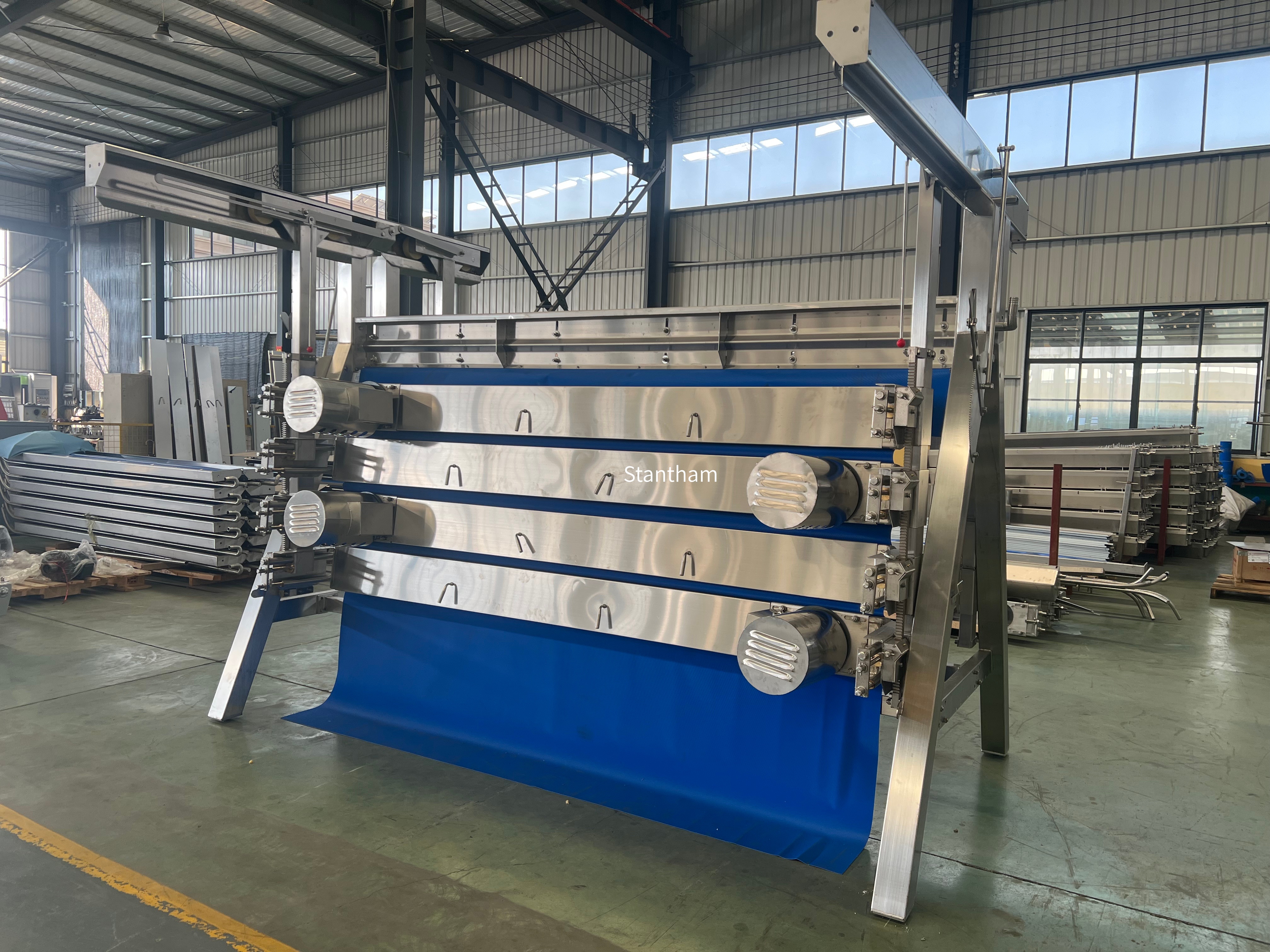
Core Energy-Saving Design Principles for Poultry Processing Equipment
Energy-efficient poultry processing equipment begins with design decisions that target the largest thermal and electrical loads in the plant: scalding, cooking, refrigeration, and line conveyance. The following principles reduce energy intensity without compromising throughput or food safety.
Thermal Recovery Integration in Scalding and Cooking Units
Scalding and cooking units generate large volumes of hot water, steam, and exhaust vapor—most of which is conventionally vented or discharged to drain. Integrating thermal recovery captures this otherwise wasted energy. Plate heat exchangers recover heat from scald tank overflow and flue gases to preheat incoming fresh water for scalding or sanitation. A 2023 food processing energy audit found that exhaust vapor from continuous cookers can represent 50–65% of total fuel input, and heat recovery systems can reduce water heating energy by 20–30% (Energy Efficiency in Food Processing 2023). Closed-loop condensate return further lowers makeup water demand and chemical treatment costs. Crucially, recovery capacity must be sized for peak production batches—not average flow—to avoid energy loss during start-up or shift transitions. These loops deliver maximum value when integrated with programmable logic controllers that adjust heat exchange in real time based on discharge temperature.
Variable-Frequency Drive (VFD) Optimization Across Conveyor and Chiller Systems
Variable-frequency drives (VFDs) match motor speed to actual process load instead of running equipment at fixed full speed. In poultry processing, conveyor lines and chillers frequently operate below design capacity, yet standard motors draw full power regardless. Applying VFDs to evisceration conveyors, air chillers, and pumps enables dynamic speed reduction during low-throughput periods—cutting energy use dramatically due to the cube law relationship: a 20% speed reduction lowers power consumption by approximately 50% (U.S. DOE 2022). VFD-controlled compressors and fans also eliminate short-cycling and maintain tighter temperature bands in chiller systems. Effective implementation goes beyond installation—it requires commissioning drive parameters to prevent harmonic distortion and staging multiple compressors intelligently based on real-time load. Field data from Lawrence Berkeley National Laboratory (2021) shows 15–35% electrical savings on VFD-controlled chiller and conveyor systems, confirming this as one of the highest-return upgrades for energy-efficient processing lines.
Modular, Insulated Enclosures to Minimize Heat Loss and Condensation Energy Waste
Thermal enclosures around scalding tanks, cookers, and chilled zones reduce both direct heat loss and the secondary refrigeration load caused by condensation. Uninsulated surfaces radiate heat continuously, while moisture condensing on cold equipment increases dehumidification and refrigeration demand. Modular panel systems with closed-cell insulation cut surface temperature differentials, reducing heat loss from piping and vessels by up to 45% (Processing Plant Insulation Survey 2023). Because poultry plants undergo frequent wash-downs, enclosures must be sealed and corrosion-resistant to preserve insulation integrity. Modular construction allows selective access and replacement without full-line shutdowns. By keeping heat where it’s needed—and preventing condensation—the approach simultaneously lowers fuel and electricity demand while supporting food safety through reduced drip contamination and lower sanitation energy requirements.
Stage-Specific Energy-Efficient Poultry Processing Equipment
Stage-focused upgrades deliver the strongest returns when they target heat-intensive and refrigeration-heavy steps. Scalding and evisceration cooling demonstrate how redesigning a single stage can cut utility demand without reducing throughput or compromising food safety.
Low-Flow, High-Turbulence Immersion Scalders with Closed-Loop Water Reuse
Conventional immersion scalders rely on continuous overflow to maintain hygiene—wasting both water and thermal energy. Low-flow, high-turbulence scalders replace large-volume baths with directed nozzles that agitate water around carcasses, improving convective heat transfer. This allows effective scalding at lower temperatures and volumes. A closed-loop system filters, pasteurizes, and reuses process water rather than discharging it. Facility-level audits from 2023 report fuel or steam use reductions of 22–30% and fresh water intake cuts of up to 45%. Lower water volume also shrinks wastewater treatment energy. To meet strict hygiene standards, closed-loop reuse requires continuous turbidity and temperature monitoring—but payback is typically under three years in mid-size plants.
Vacuum-Cooled Evisceration Lines Reducing Refrigeration Load by 22–30%
After evisceration, rising carcass temperature drives heavy downstream refrigeration demand. Vacuum-cooled evisceration lines use reduced pressure to flash-evaporate surface moisture, removing latent heat rapidly before carcasses enter the chiller. This pre-cooling step reduces refrigeration load on primary chilling systems by 22–30%, according to 2024 comparative trials across two high-volume facilities. Unlike forced-air pre-chilling—which can desiccate exposed tissue—vacuum cooling improves moisture retention. Operators report reduced compressor work, fewer defrost cycles, and lower peak electrical demand. Key success factors include maintaining vacuum pump seals, recovering condensate, and synchronizing dwell time with line speed to prevent bottlenecks. These gains compound when paired with variable-speed chiller control.
Proven Performance: Energy Savings from Real Abattoir Implementations
A Danish Abattoir’s Spiral Freezer Retrofit: 37% Reduction via EC Motors and AI-Based Load Matching
A major Danish poultry plant retrofitted its spiral freezer using electronically commutated (EC) motors and AI-based load matching—cutting freezer energy use by 37% while maintaining stable product core temperatures. Real-time load matching aligns fan and compressor output precisely to actual carcass flow, eliminating wasteful constant-speed operation during gaps or partial loads. EC motors reduce electrical losses and reject less heat into the refrigerated space—lowering the refrigeration system’s workload. Engineers measured energy intensity before and after under comparable weekly volumes, with no changes to line speed or temperature setpoints. Payback was achieved in under two years. This retrofit confirms that targeted, intelligent upgrades can deliver repeatable, high-impact savings without compromising throughput or food safety.
Regulatory and Technological Drivers Advancing Next-Generation Poultry Processing Equipment
EU EcoDesign Directive 2023 Updates and Compliance Implications for Poultry Processing Equipment
The updated EU EcoDesign Directive shifts compliance from motor-level efficiency to whole-system energy performance. For poultry processing equipment, chillers, scalders, and conveyor drives must now meet stricter part-load efficiency thresholds. Many new installations require IE4-class motors combined with variable-frequency drives to remain market-accessible. Processors must document real-world load profiles and verify performance under partial-load conditions—not just at rated capacity. Modular design and staged retrofits allow existing equipment to achieve compliance without full line replacement, reducing both capital cost and operational downtime.
FAQ
What is thermal recovery in poultry processing equipment?
Thermal recovery captures heat from processes like scalding or cooking, which would otherwise be wasted, to preheat water and reduce energy use.
How do variable-frequency drives save energy in poultry processing?
Variable-frequency drives (VFDs) adjust motor speed to match the actual process load, avoiding excess energy consumption and reducing power usage significantly during low-throughput periods.
What are modular insulated enclosures and how do they help?
Modular insulated enclosures reduce heat loss and condensation energy waste around equipment like scalding tanks and chillers, while also supporting food safety and lowering energy demand.
What benefits do closed-loop water reuse systems provide in scalding?
Closed-loop water systems filter and reuse process water rather than discharging it, reducing water intake, thermal energy usage, and wastewater treatment costs.
How does vacuum cooling reduce refrigeration load?
Vacuum cooling pre-cools carcasses by rapidly evaporating surface moisture, reducing the downstream refrigeration system’s workload and preserving moisture retention.
Table of Contents
- Core Energy-Saving Design Principles for Poultry Processing Equipment
- Stage-Specific Energy-Efficient Poultry Processing Equipment
- Proven Performance: Energy Savings from Real Abattoir Implementations
- Regulatory and Technological Drivers Advancing Next-Generation Poultry Processing Equipment
-
FAQ
- What is thermal recovery in poultry processing equipment?
- How do variable-frequency drives save energy in poultry processing?
- What are modular insulated enclosures and how do they help?
- What benefits do closed-loop water reuse systems provide in scalding?
- How does vacuum cooling reduce refrigeration load?